







Project Information
Country
United States
Industry
Enterprise Data
Organization Size
51–200 Employees
Solution Area
Azure SQL Migration and Data Platform Modernization
Products & Services
• Microsoft Azure
• Azure SQL Managed Instance
• Azure SQL Database
• Private Endpoints
• Global VNet Peering
• Private DNS Zones
• Managed Instance Link
• Azure Files
• Azure Monitor
About the Organization
Surgere manages enterprise-scale data workloads running across multiple Azure tenants, regions, and virtual networks.
Its SQL environment was built on Azure Virtual Machines. Over time, that setup started creating friction. Scaling was not straightforward, and managing cross-tenant connectivity added complexity. Security requirements were also evolving, especially around private-only access.
Challenge
The objective was clear. Move to a modern SQL platform without disrupting production workloads. The environment made that difficult.
- Distributed architecture: More than 18 virtual networks across tenants
- Multiple dependencies: Applications spread across regions with shared data paths
- Private connectivity requirements: All traffic needed to remain private
- DNS and networking complexity: Private DNS zones and routing needed alignment
- Downtime constraints: Migration had to happen without interrupting production systems
Traditional migration methods were not suitable. Backup and restore approaches would introduce downtime, which was not acceptable here.
Solution
IFI Techsolutions designed a migration approach centered on continuous replication and private connectivity. The idea was to keep both environments running in parallel until the transition was complete.
- Managed Instance Link used for real-time replication between source and target
- Azure SQL Managed Instance deployed, with separate environments for development and production
- Private Endpoints implemented across all SQL workloads to remove public exposure
- Global VNet peering configured to connect environments across tenants
- Private DNS zones aligned to support consistent name resolution
- Azure Monitor enabled for visibility and alerting
The migration avoided downtime by maintaining continuous synchronization throughout the process.
Architecture Overview
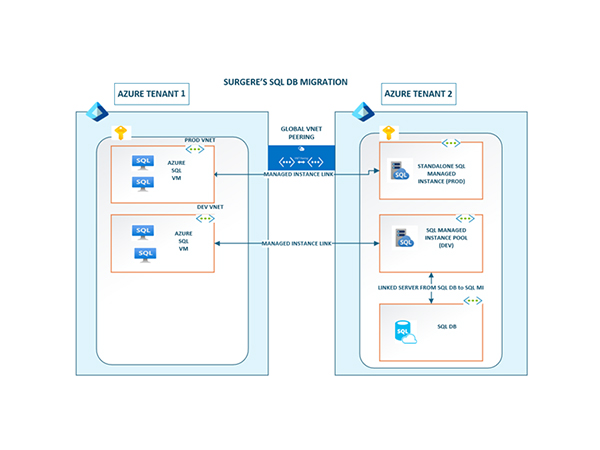
| Area | Implementation |
| Source | Azure SQL VM |
| Target | Azure SQL Managed Instance (Instance Pool + Standalone) |
| Connectivity | Global VNet Peering across tenants |
| Security | Private Endpoints with private-only access |
| DNS | Private DNS Zones |
| Migration Method | Managed Instance Link (real-time replication) |
| Storage | Azure Files |
| Monitoring | Azure Monitor |
Implementation Challenges
Cross-tenant networking
Connecting environments across tenants introduced routing and dependency issues. Some connections behaved differently once traffic moved across peered networks.
Private endpoint and DNS alignment
After private endpoints were introduced, DNS resolution needed careful adjustment. Without that, applications could not consistently resolve database endpoints.
Approach and Resolution
- Established global VNet peering with validated routing paths
- Aligned private DNS zones to ensure consistent name resolution across environments
- Configured and stabilized private endpoints across regions
- Used Managed Instance Link to maintain real-time data synchronization
The process was iterative. Some issues only appeared once all components were connected.
Impact
Once the migration completed, the system behaved more predictably.
- Near-zero downtime migration, with production systems remaining active
- Real-time data synchronization maintained throughout the transition
- Private-only architecture enforced, improving security posture
- Improved scalability, with fewer constraints across regions
- Cost optimization for non-production workloads through Instance Pool usage
There were no major disruptions during the move. That was the main outcome.
Conclusion
The move to Azure SQL Managed Instance changed how the platform is operated.
The environment is easier to scale, easier to secure, and less dependent on manual coordination across tenants. Real-time replication removed the need for downtime, which was a key requirement from the start. The architecture now supports growth without adding the same level of complexity.